Diversity and phylogeny of Sleep
Written by Alessandro MICACCIA
no comments
Classified in : Behavior
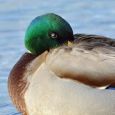
Sleep is a fascinating topic to me. It's a behavior with many ecological
and evolutionary implications, since animals will dedicate a bit of
time to it every day. A state where they stop being active and are
vulnerable... Or are they?
Presentation done for class on march 15th, 2024 (Second year)
Sleep is a mysterious behavior with many unresolved questions regarding its functions and mechanisms. What we know is that all animals with a nervous system need some kind of sleep. In sperm whales for example, sleep is articulated with needs such as breathing, hence they sleep close to the surface to optimize the breaks taken to breathe.
First of all, sleep is defined behaviorally as a reversible state of relative inactivity that has the property of recovery : if you lack sleep one day, you will sleep longer the next day to recuperate. Sleep, at least in humans and other mammals, comes in two types that alternate in cycles during the night : on the one hand, there is REM (with characteristic Rapid Eye Movement), also called paradoxical sleep, and on the other hand, Non-REM, or Slow Wave Sleep. They have distinct properties and different functions too, with for example NREM specifically associated with sedimenting new knowledge in the brain.
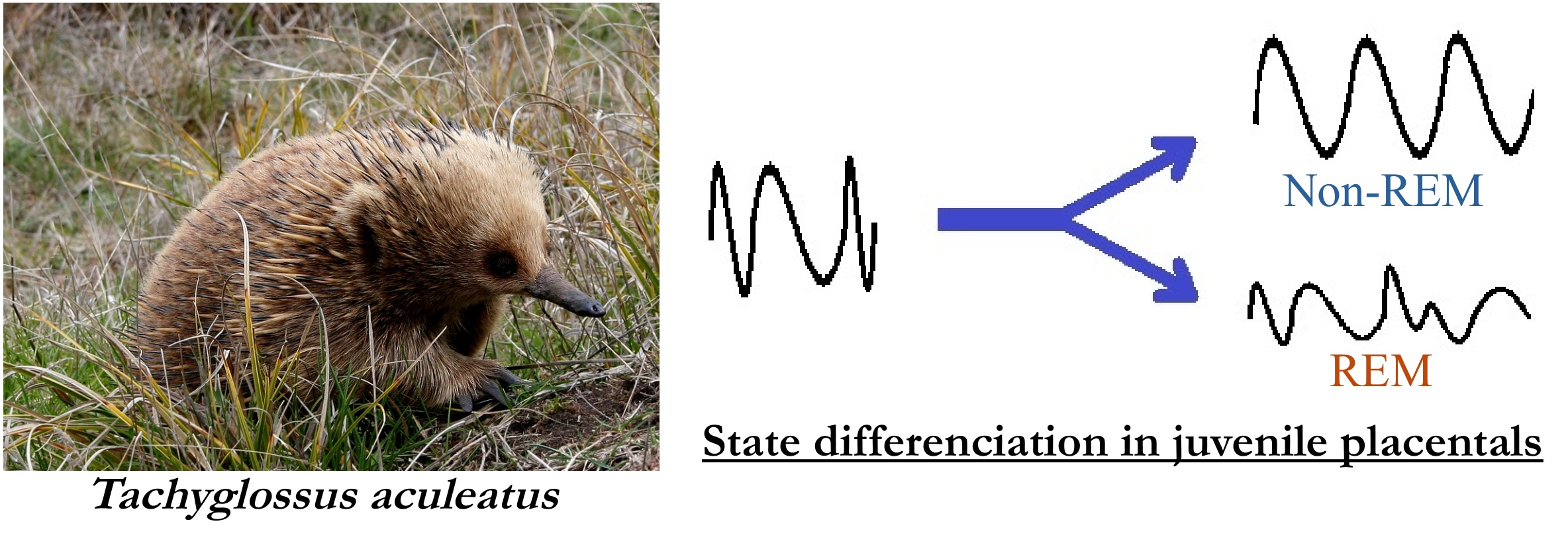 The echidna (Tachyglossus aculeatus) only has one state of sleep though ; a state with some characteristic of both phases at once. Which actually resembles what we have in prenatal dogs and mice, before sleep states differentiate.
Since the echidna is a monotreme, a small group that diverged early from all the other extant mammals, it has been suggested that this kind of sleep is an ancestral state, a state shared by the ancestor of all extant mammals. Hence Ontogeny recapitulates phylogeny (development reproduces all the trends in the evolutionary lineage in order) in common lab mammals and humans. However, this distinction in two phases also exists in birds and at least in some reptiles, so this could just as well be a case of neoteny (retaining juvenile traits into adulthood), which is equally as cool if you ask me.
Now let's talk about the role of REM sleep. This is interesting because many animals actually don't have REM sleep at all, but all animals will retain NREM. All the animals who can go into unihemispheric sleep are prime examples : in this kind of sleep, one hemisphere of the brain is in NREM while the other is awake, before alternating. This way, animals such as alligators and migrating birds are always kinda aware of what happens around them and can react.
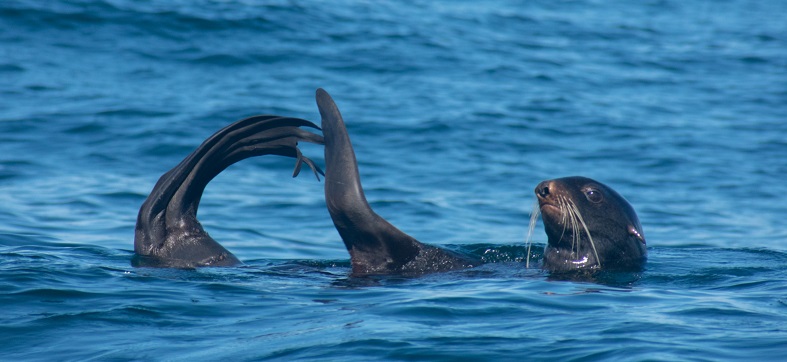
Fur seal displaying unihemispheric sleep. (c) Danny Tipton (iNaturalist)
Among these particular sleepers, the fur seal (Callorhinus ursinus) is even more particular. They happen to sometimes go into unihemispheric sleep (when they're at sea), and sometimes go into REM sleep with both hemispheres, especially when they can get on land. And cherry on the cake, when they do, they don't need to recuperate the REM sleep they've "lost" at sea. This means that, as surprising as it may seem, unihemisphering sleep may have some downside on land, but most importantly, it seems to replace REM sleep at sea. In other words, keeping one hemisphere awake might mitigate the need of a wake-like REM state of sleep.
But what exactly is the function of the REM phase then ?
One major hypothesis for the function of REM sleep is that it warms the brain back up after a long period of NREM, since neurons are way less active in that phase. While this observation is true for birds and mammals, it isn't for the bearded dragon (Pogona vitticeps), a lizard with a two-state sleep similar to us in which brain temperature remains stable throughout sleep. This means that the REM like phase must have another function for them that we don't know of.
As you can see, there is so much we still don't know about sleep, especially outside of humans. Which makes the topic all the more exciting!
Thank you for coming with me on this fun little ride. You can find the slides (including references) of this presentation by following this link.
Until next time, have a good one folks!
